01
Top to bottom

主(zhǔ)— main / master
Write upper strokes before lower strokes.
Writing Practice · A Visual Guide
Stroke order, character structure, Mi Zi Ge grids, and simple routines for practicing Hanzi by hand.
Good writing practice is not just copying characters. It means seeing the structure, following the stroke order, and repeating with intention.
永 (yǒng) — eternal
Notice structure
Writing slows you down enough to see how a character is actually built — the parts, the order, the proportions.
Improve visual memory
Producing a character by hand creates a stronger visual trace than recognising it on a screen.
Avoid common mistakes
Tiny differences between similar Hanzi become obvious the moment you have to write them yourself.
Stroke order is not random. Chinese characters are usually written in a predictable sequence that makes writing smoother, more balanced, and easier to remember.
主(zhǔ)— main / master
Write upper strokes before lower strokes.

吃(chī)— to eat
Write the left component before the right component.
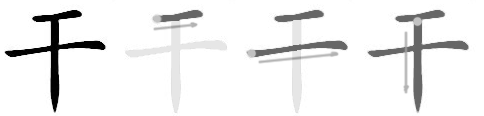
干(gān / gàn)— dry / to do
Horizontal strokes usually come before vertical strokes.

回(huí)— to return
Write the outer frame before the inside part.

日(rì)— sun / day
For boxed characters, write the closing bottom stroke last.
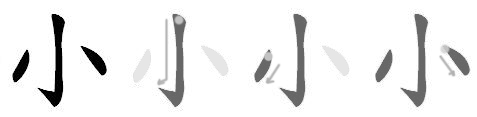
小(xiǎo)— small
In some symmetrical characters, the center stroke comes before the sides.
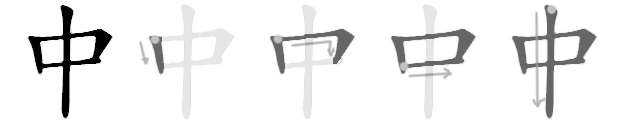
中(zhōng)— middle
For characters with a central vertical stroke, write the surrounding shape first, then the central stroke.
Most Chinese characters are made of smaller parts arranged in a recognisable pattern. Spotting that pattern first makes writing more controlled and far less random.
(hǎo) — good
(nǚ) — woman
(zǐ) — child
Single component
A self-contained character with no further breakdown.
(rén)
person
(shān)
mountain
(mù)
tree / wood
Left–right
Two parts side by side; the left part is often the meaning radical.
(hǎo)
good
(nǐ)
you
Top–bottom
Parts stacked vertically.
(xué)
to study
(zì)
character
Surrounding / enclosure
An outer frame wraps an inner element.
(guó)
country
(wèn)
to ask
(huí)
to return
Complex multi-part
Several components combined in a more intricate layout.
(xiè)
to thank
(yǐng)
shadow / image
Mi Zi Ge grids help beginners center characters, balance components, and control proportions. The center lines and diagonals act as a quiet guide for every stroke.
Without grid
Inside Mi Zi Ge
With guide strokes
Empty grid
好 (hǎo) — good
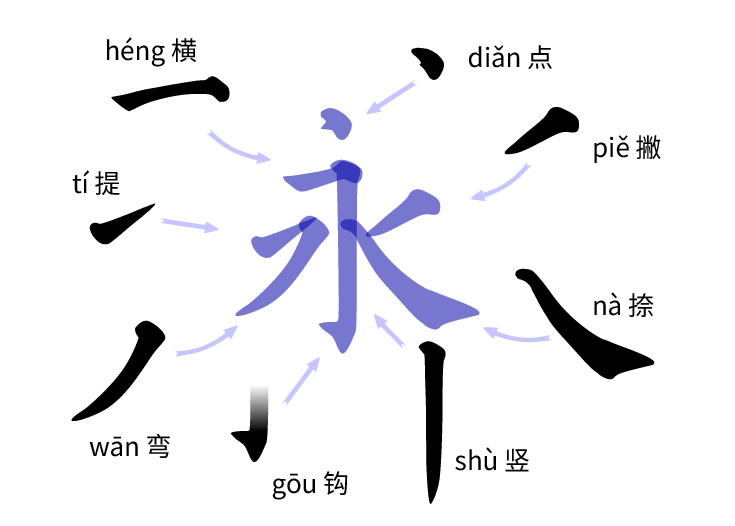
永 (yǒng) — eternal — shows many of the basic stroke types used in Chinese writing.
You do not need to study calligraphy to write clearly. But 永 (yǒng) is a useful way to recognise the basic stroke types and how they connect.
Look, break down, trace, copy, recall, repeat.
Read the character, its pinyin, and meaning.
Identify the structure and components.
Write slowly, stroke by stroke.
Practice over faded guide characters.
Write in empty grids with no guide.
Cover the model and write from memory.
This turns writing practice from passive copying into active learning.
Free writing practice downloads
Blank Mi Zi Ge Sheets
Printable 米字格 (mǐ zì gé) writing grids for daily handwriting practice.
HSK 1 Sample Pages
Practice selected HSK 1 words with stroke order, example sentences, and writing grids.
Character Decomposition Chart
Break characters into structure, components, pinyin, and meaning.
Practice with structure
Use structured workbooks and notebooks to turn handwriting practice into a regular habit.
HSK Writing Practice Workbooks
Vocabulary, stroke order diagrams, example sentences, and writing grids by HSK level.
Mi Zi Ge Handwriting Notebooks
Bound notebooks of 米字格 grids for regular daily writing practice.
Free Character Practice Resources
Printable sheets and guides for stroke order, decomposition, and structure.
Common writing questions